Epic Research is not viewable using Internet Explorer. Please try accessing it with an alternate browser.
Weight Change During the Second Year of Semaglutide UseExpand
Cosmos Study

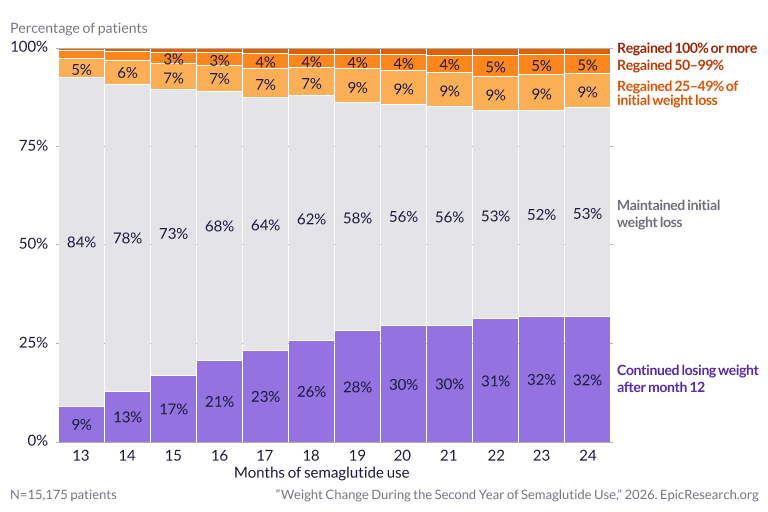
Most Adults Without Diabetes Maintain Their GLP-1 Weight Loss Through a Second Year, Though Gradual Regain Begins After the One-Year Mark

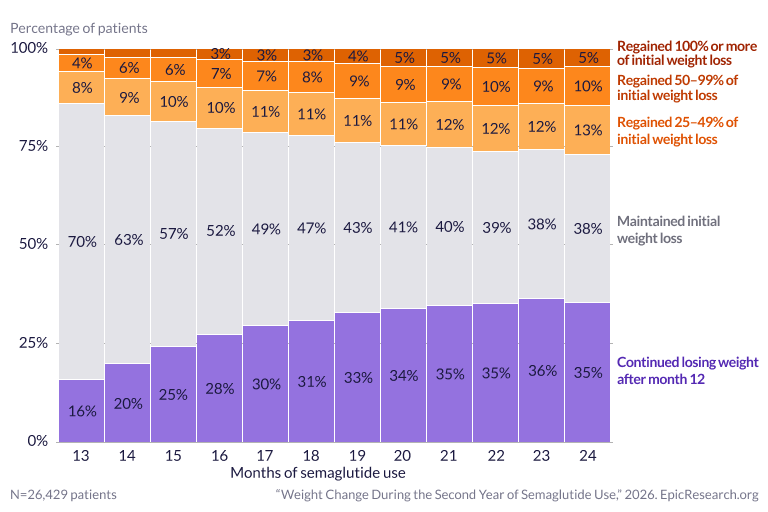
Among adults without diabetes who lost weight during their first year on a GLP-1 medication, most sustained that loss into the second year. At the two-year mark, 53.1% of semaglutide patients and 52.9% of tirzepatide patients had maintained their weight within a narrow band of their one-year weight, and a further 31.9% (semaglutide) and 39.3% (tirzepatide) had lost even more.

Dual-Team Study|August 13, 2026
Weight Change During the Second Year of Semaglutide UseExpand
Cosmos Study

Adults with Diabetes on GLP-1s Largely Maintain Their First-Year Weight Loss

Among adults with diabetes who lost weight during their first year on a GLP-1 medication, most maintained or extended that loss when the GLP-1 was continued into the second year. At the two-year mark, 37.7% of semaglutide patients and 47.3% of tirzepatide patients had maintained their weight loss, and another 35.4% and 38.6%, respectively, had continued to lose weight.

Dual-Team Study|August 12, 2026

Recent Posts


Likelihood of On-Time Cancer Screening by Presence of Autism DiagnosisExpand
Cosmos Study

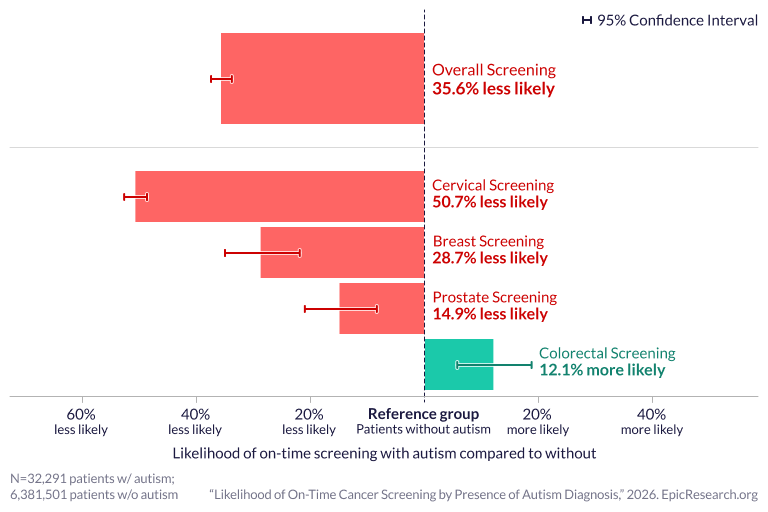
Patients Diagnosed with Autism Are Less Likely to Receive On-Time Cancer Screening, Except for Colorectal Cancer

Among patients newly eligible for cancer screening, those diagnosed with autism had a 35.6% lower likelihood of on-time screening overall compared to patients without autism. The gap was largest for cervical (50.7% lower likelihood) and breast (28.7% lower likelihood) cancer screening, and smaller but still significant for prostate cancer screening (14.9% lower likelihood).

Dual-Team Study|July 28, 2026

Featured Posts


See All Epic Research Articles