Epic Research is not viewable using Internet Explorer. Please try accessing it with an alternate browser.
Cosmos Study

No Correlation Found Between Testicular Cancer and Testosterone Replacement Therapy

February 1, 2024
Dual-Team Study
Team A:Kersten Bartelt, RNJoe Deckert, PhD
Team B:Blaine Franklin, PT, DPTNeil Sandberg

Key Findings

  • Testosterone replacement therapy (TRT) use is not correlated with an increased rate of testicular cancer.

Testosterone replacement therapy (TRT) is a treatment used for men with low testosterone levels. A prior study showed a correlation between TRT use and prostate cancer,1 although more recent studies have shown no increase in the risk of prostate cancer in patients undergoing TRT.2,3 There has been limited investigation into the potential risk of TRT on a patient developing testicular cancer. We aimed to assess whether there is an increased risk of testicular cancer among patients receiving TRT. 

To assess how TRT affects the risk of testicular cancer, we completed a case-control study on 6,649 patients with low testosterone who were diagnosed with testicular cancer or who had an annual exam between January 1, 2018, and June 1, 2023. We matched on patient race, ethnicity, and date of testicular cancer diagnosis or annual exam. We found no significant difference in the rate of testicular cancer for patients treated with TRT and those not treated with TRT (19.8% vs 20.0%), as seen in Figure 1.
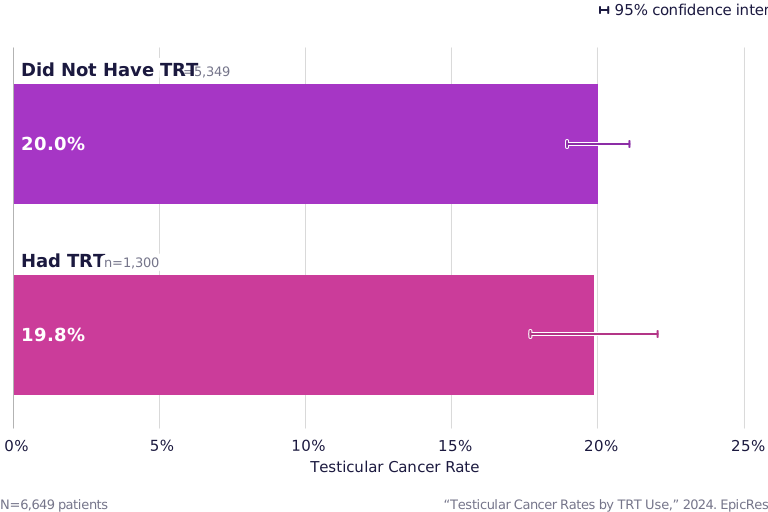
Figure 1
Testicular Cancer Rates by TRT Use
Figure 1. The percentage of patients with testicular cancer stratified by TRT use.

A sensitivity analysis adjusting for patient age, rural-urban classification, and social vulnerability also did not identify a statistically significant increase in the risk of testicular cancer following TRT. 


These data come from Cosmos, a collaboration of 238 Epic health systems representing more than 233 million patient records from 1,325 hospitals and more than 28,900 clinics from all 50 states and Lebanon. This study was completed by two teams that worked independently, each composed of a clinician and research scientists. The two teams came to similar conclusions. Graphics by Brian Olson. 

References

  1. Huggins C, Hodges CV. Studies on prostatic cancer. I. The effect of castration, of estrogen and androgen injection on serum phosphatases in metastatic carcinoma of the prostate. CA Cancer J Clin. 1972;22(4):232-240. doi:10.3322/canjclin.22.4.232 
  2. Debruyne FM, Behre HM, Roehrborn CG, et al. Testosterone treatment is not associated with increased risk of prostate cancer or worsening of lower urinary tract symptoms: prostate health outcomes in the Registry of Hypogonadism in Men. BJU Int. 2017;119(2):216-224. doi:10.1111/bju.13578 
  3.  Lenfant L, Leon P, Cancel-Tassin G, et al. Testosterone replacement therapy (TRT) and prostate cancer: An updated systematic review with a focus on previous or active localized prostate cancer. Urol Oncol. 2020;38(8):661-670. doi:10.1016/j.urolonc.2020.04.008