Patients hospitalized with COVID-19 are more likely to develop sepsis and septic shock when compared to patients admitted with influenza during the 2016, 2017, or 2018 flu seasons, according to EHR data.
Sepsis is defined as a clinical condition of life-threatening organ dysfunction caused by an abnormal response to infection. Septic shock is a subset of sepsis involving a severe decrease in blood pressure and other metabolic abnormalities, presenting a greater risk of death than with sepsis alone.1 Early studies identified a high incidence of sepsis in patients with COVID-19.2,3 Pathophysiologic investigations have pointed to viral sepsis as a serious manifestation of disease in COVID-19 patients.4-6 To explore the incidence of sepsis in COVID-19 compared to other viral illnesses, we examined data from patients who were admitted to the hospital during their COVID-19 illness (n=66,236) and data from patients who were admitted for influenza during the influenza season in 2016, 2017, or 2018 (n=56,896). The incidence of sepsis, septic shock, and inpatient mortality are reported for each population in Table 1 below.
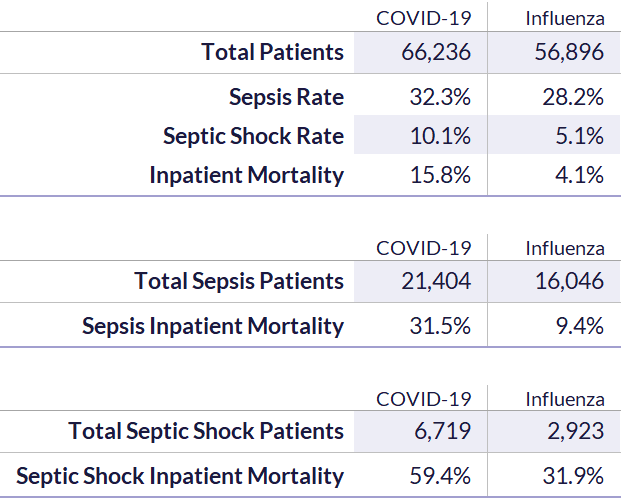
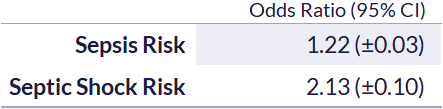
Among hospitalized patients, overall inpatient mortality incidence was much higher in patients with COVID-19 (15.8%) than influenza (4.1%). The incidence of sepsis and septic shock were also higher in the COVID-19 population. In order to better understand the magnitude of this, we modelled the association between sepsis or septic shock and COVID-19, controlling for age and sex. Hospitalized patients with COVID-19 are 22% more likely to develop sepsis, and 113% more likely to develop septic shock compared to hospitalized patients with influenza (Table 2).
In response to these findings, physicians should be vigilant and use all available resources in the early detection and treatment of sepsis in patients with COVID-19. Additional research would be beneficial to identify the risks for sepsis in COVID-19, the mechanisms of its development, and the optimal approaches to management.
This study was completed by two teams each comprised of a clinician and two research scientists who worked independently analyzing the risk of sepsis between patients with COVID-19 and those with influenza. The two teams came to similar conclusions. Data are pooled from 83 healthcare organizations representing 358 hospitals that span 47 states and cover 52 million patients.
References
- Singer M, Deutschman CS, Seymour CW, et al. The Third International Consensus Definitions for Sepsis and Septic Shock (Sepsis-3). JAMA. 2016 February 23; 315(8): 801–810.
- Zhou F, Yu T, Du R, et al. Clinical Course and Risk Factors for Mortality of Adult Inpatients with COVID-19 in Wuhan, China: A Retrospective Cohort Study. Lancet 2020;395:1054-62.
- Guan W, Ni Z, Hu Y, et al. Clinical Characteristics of Coronavirus Disease 2019 in China. N Engl J Med 2020;382: 1708-20.
- Li H, Liu L, Zhang D, et al. SARS-CoV-2 and Viral Sepsis: Observations and Hypotheses. Lancet 2020;395:1517-20.
- Liu D, Wang Q, Zhang H, et al. Viral Sepsis is a Complication in Patients With Novel Corona Virus Disease (COVID-19). Medicine in Drug Discovery 2020;8:100057.
- Lin G, McGinley JP, Drysdale SB, et al. Epidemiology and Immune Pathogenesis of Viral Sepsis. Front Immunol. 2018 Sep 27;9:2147.


