


A large body of previous research has demonstrated racial gaps in autism diagnosis, with White children diagnosed with autism spectrum disorder (ASD) earlier and more often than children in other racial and ethnic groups1,2. More recent analyses, such as those by the CDC, have found that those gaps are declining3. In our analysis, we found further evidence that efforts to reach parity across rates of diagnosis and age of diagnosis have been successful as those differences are declining across all racial groups.
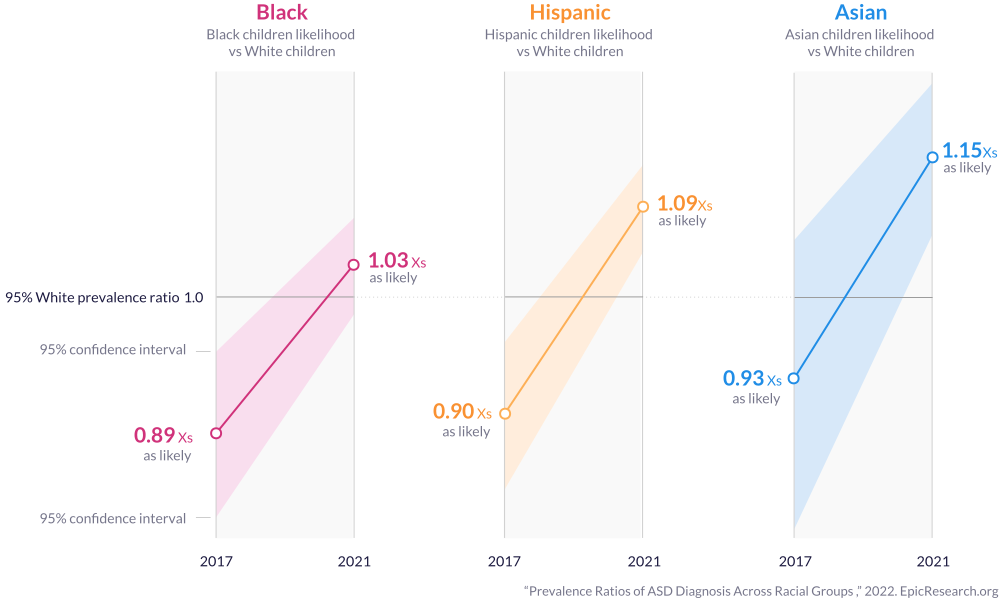
To evaluate racial differences in the likelihood of diagnosis and align with the CDC analyses3, we evaluated the prevalence of ASD by race in children who were exactly 8 years old at some point in the study year. In 2017, 2.2% (260/11,835) Asian children, 2.1% (1,076/51,470) Black children, 2.1% (1,311/61,718) Hispanic children, and 2.4% (3,886/164,728) of White children were diagnosed with ASD. In 2021, 4.7% (632/13,499) Asian children, 4.2% (2,324/55,671) of Black children, 4.4% (2,781/62,815) of Hispanic children, and 4.0% (6,778/167,579) of White children were diagnosed with ASD. Figure 1 shows how likely children of other races were to be diagnosed with autism as compared to White children in 2017 and 2021. For example, Black children were about 11% less likely than White children to be diagnosed with autism in 2017. However, by 2021, Black children were about 3% more likely than White children to be diagnosed with ASD.
We separately assessed the median age at diagnosis across racial groups by evaluating children between 8 and 17 years old to determine when they were first diagnosed with ASD. We didn’t include younger children because ASD often isn’t diagnosed until later in childhood, and we wanted to make sure that our analysis focused on children likely to have already received a diagnosis.
We found that the age of diagnosis was consistent across racial groups when adjusted for age differences across the underlying population. By the end of the study period, all groups had a median age at diagnosis between 4.4 and 4.9 years, with Asian children having the youngest median age at diagnosis and White children having the oldest median age.
Our analysis found that racial disparities in the identification and diagnosis of ASD have decreased, and ASD diagnosis has become slightly more likely in non-White children in our sample. Experts have suggested that this change might be due to more effective outreach across racial groups and increased efforts to improve autism screening for all children, such as the CDC’s Learn the Signs. Act Early. program.4 Our findings suggest that states and communities should continue to follow targeted strategies to promote racial equity in awareness and identification of ASD.
