Epic Research is not viewable using Internet Explorer. Please try accessing it with an alternate browser.
Cosmos Study

Greatest Risk of Self-Harm Occurs Early in Depression Treatment

May 10, 2023
Dual-Team Study
Team A:Kersten Bartelt, RNJoe McNitt
Team B:Gretchen Vitek, RN, MSNEric Barkley

Key Findings

  • Patients are at greatest risk of self-harm events soon after initially being prescribed an antidepressant. Adolescents ages 12-17 years old are at the greatest risk of self-harm with a risk nearly five times greater than the general population. Adolescent females are especially at risk. 
  • No significant increase in risk of self-harm after discontinuation of antidepressants was observed. 
  • Most patients (69%) did not have an active antidepressant prescription at the time of their first self-harm event. 

Previous studies have explored the relationship between the use of antidepressant medications and self-harm events.1-5 Less is known about whether starting or stopping a medication for depression increases the likelihood of self-harm, and when patients are at greatest risk.

To better understand how risk of self-harm is influenced by starting or discontinuing antidepressants, we analyzed 8,402,030 patients with no history of self-harm or suicide attempt when initially prescribed antidepressants and 1,039,745 patients with an initial self-harm event from 2017 to 2022. We excluded patients with a prior history of self-harm or suicide attempt.

We analyzed the incidence of self-harm for patients who were currently or previously prescribed an antidepressant. As seen in Figure 1, the risk of a self-harm event is greatest soon after initial antidepressant medication prescribing with a maximum weekly rate 20 times greater than the risk of novel self-harm after discontinuation of antidepressant medication (76 per 100,000 patients compared to 3.8 per 100,000 patients).
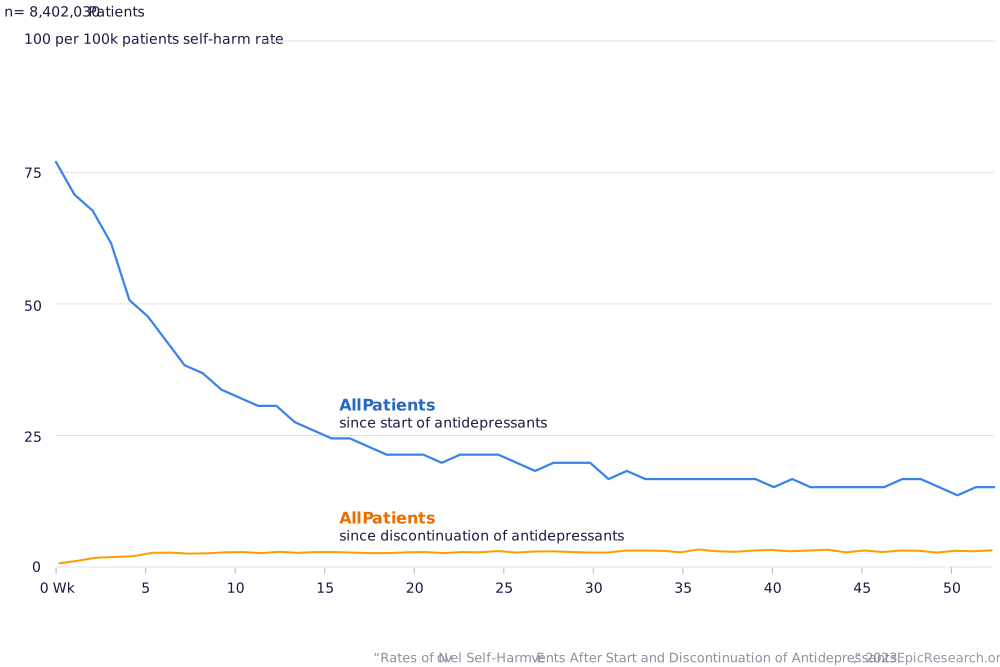
Figure 1
Rates of Novel Self-Harm Events After Start and Discontinuation of Antidepressants
Figure 1. Weekly rate of novel self-harm since the initial prescribing or discontinuation of antidepressant medication.

However, the rate of self-harm is not equal across age groups. Adolescents ages 12-17 have the greatest risk in both populations. They are nearly five times more likely to experience a novel self-harm event in the first few months after being prescribed antidepressants than the overall population, as shown in Figure 2. While adolescents 12-17 are at the greatest risk of self-harm after discontinuing antidepressants compared to other age groups, their risk of self-harm after discontinuation of antidepressants does not exceed a weekly rate of 18 per 100,000 patients in the first year.
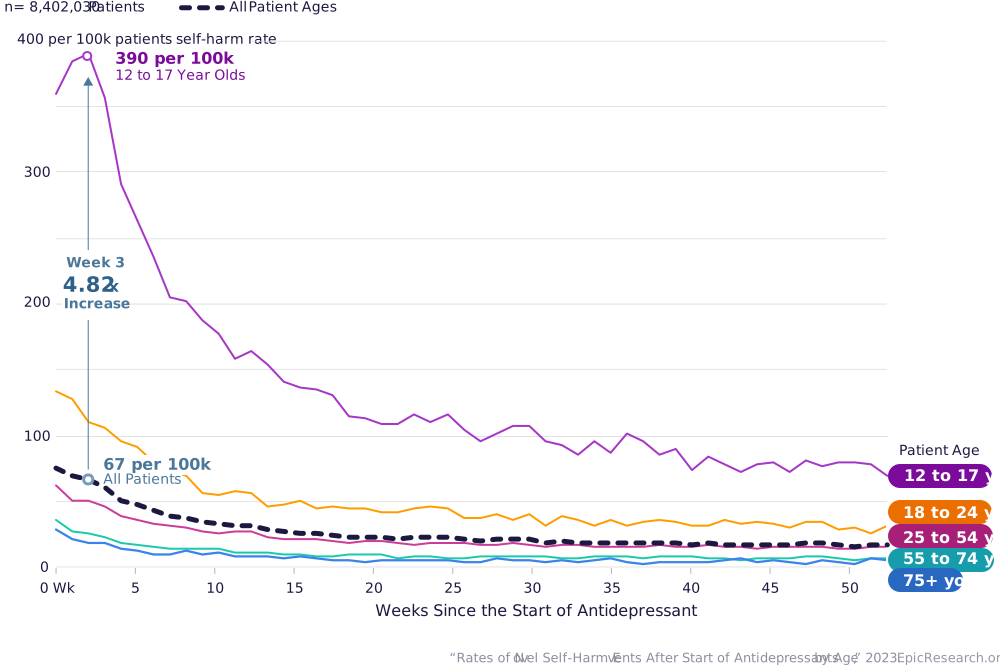
Figure 2
Rates of Novel Self-Harm Events After Start of Antidepressants by Age
Figure 2. Rate of novel self-harm events over weeks since the initial prescribing of antidepressant medication stratified by age.

Additionally, similar to our previous study, we found that female adolescents were more likely than male adolescents to have a novel self-harm event after the start of antidepressants (414 per 100,000 females and 344 per 100,000 males at week 3).6 However, males ages 18-24 were slightly more likely to experience a novel self-harm event after the start of antidepressants than females of the same age (147 per 100,000 for males and 100 per 100,000 females at week 3). 

These findings enumerate the risk of novel self-harm after discontinuation of antidepressants. Of note, the majority of patients (69%) did not have an active antidepressant prescription at the time of their initial self-harm event.


These data come from Cosmos, a HIPAA-defined Limited Data Set of more than 183 million patients from 193 Epic organizations including 1,119 hospitals and more than 24,500 clinics, serving patients in all 50 states and Lebanon. This study was completed by two teams that worked independently, each composed of a clinician and research scientists. The two teams came to similar conclusions.

References

  1. Didham RC, McConnell DW, Blair HJ, Reith DM. Suicide and self-harm following prescription of SSRIs and other antidepressants: confounding by indication. British Journal of Clinical Pharmacology. 2005;60(5):519-525. doi:10.1111/j.1365-2125.2005.02480.x
  2. Chai Y, Luo H, Man KKC, et al. Antidepressant use and risk of self-harm among people aged 40 years or older: A population-based cohort and self-controlled case series study. The Lancet Regional Health – Western Pacific. 2022;27:100557. doi:10.1016/j.lanwpc.2022.100557
  3. Whitely M, Raven M, Jureidini J. Antidepressant Prescribing and Suicide/Self-Harm by Young Australians: Regulatory Warnings, Contradictory Advice, and Long-Term Trends. Frontiers in Psychiatry. 2020;11. doi:10.3389/fpsyt.2020.00478
  4. Coupland C, Hill T, Morriss R, Arthur A, Moore M, Hippisley-Cox J. Antidepressant use and risk of suicide and attempted suicide or self harm in people aged 20 to 64: cohort study using a primary care database. BMJ. 2015;350(feb18 32):h517-h517. doi:10.1136/bmj.h517
  5. Morgan C, Webb RT, Carr MJ, et al. Self-harm in a primary care cohort of older people: incidence, clinical management, and risk of suicide and other causes of death. The Lancet Psychiatry. 2018;5(11):905-912. doi:10.1016/s2215-0366(18)30348-1
  6. Little D, Barkley E, Trinkl J, Thayer J, Sandberg N. Pediatric Suicide-related Hospital Encounters for 13- to 15-Year-Olds Up 60% Since 2017. Epic Research. April 22, 2022. https://epicresearch.org/articles/pediatric-suicide-related-hospital-encounters-for-13-to-15-year-olds-up-60-since-2017